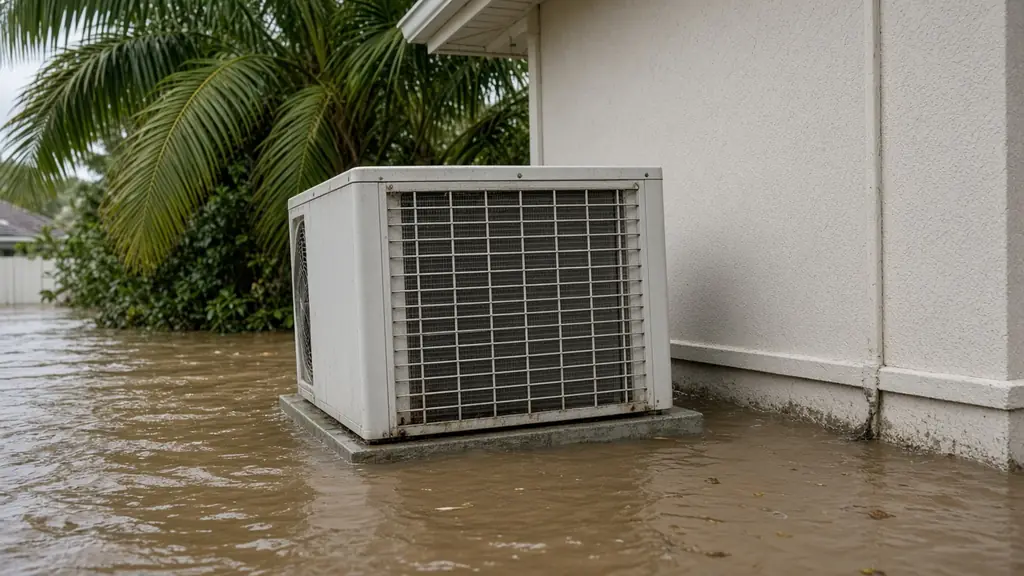
If floodwater reached your outdoor condenser, indoor air handler, ductwork or the electrical parts that feed them, don't run your AC. Shut its power off at the breaker if you can do that safely, and have a licensed HVAC technician inspect the system before anyone turns it back on.
The Space Coast flooding
Heavy rain fell across the Space Coast from November 1 to 3, 2026. On the morning of November 2, the National Weather Service (NWS) in Melbourne issued a Flash Flood Emergency for West Melbourne and Palm Bay (NWS Melbourne, Nov 2, 2026). Preliminary NWS rainfall reports through noon on November 3 show more than 24 inches near Grant-Valkaria and Malabar and 22 inches just south of Palm Bay (NWS Melbourne Public Information Statement, Nov 3, 2026). On November 3, Brevard County Emergency Management asked residents whose homes were damaged or flooded to report it through the county's online damage form. The county says the form "is not an application for assistance" (Brevard County Emergency Management; damage report form).
Outdoor AC units sit close to the ground, and many air handlers sit in garages or closets at floor level. So if water got into your home or business, your AC may have taken some too.
Step 1: Don't run it
It's tempting to turn the AC on to help dry the house out. Don't. The CDC says to have your heating, ventilation and air-conditioning (HVAC) system "checked and cleaned by a maintenance or service professional who is experienced in mold cleanup before you turn it on," because running a flooded, mold-contaminated system "will spread mold throughout the house" (CDC). The CDC also says that if your home has a whole-house HVAC system, you shouldn't turn it on until it has been inspected (CDC).
Wet electrical parts are a second risk. The CDC says all electrical equipment and appliances must be completely dry before they go back into service, and a certified electrician should check them if there's any question (CDC).
Step 2: Shut off power, but only if it's safe
- Turn off the AC breaker(s) at your main panel, and the outdoor disconnect next to the condenser, only if you can reach them from a dry spot.
- Never touch a panel, switch or disconnect while standing in water. The CDC says that if you'd have to enter standing water to reach the main power switch, call an electrician to turn it off. It also says to "NEVER turn power on or off yourself or use an electric tool or appliance while standing in water" (CDC).
- Have an electrician check the electrical system before power goes back on (CDC).
- Watch for downed power lines. Brevard County warns that floodwaters can contain downed power lines, debris and sharp objects (Brevard County Emergency Management).
Step 3: Get it checked by a licensed technician
Have a licensed HVAC technician inspect the whole system: the outdoor unit, the indoor air handler, the ductwork and the controls. When you call, it helps to have:
- Photos showing how high the water got on the outdoor and indoor units
- Whether either unit moved or tilted
OBC Air & Heat technicians are EPA 608-certified to handle refrigerant.
Repair or replace? What a technician looks at
Every flooded system is different. The CDC says professional consultation is helpful in deciding whether an HVAC system needs to be replaced or whether repairs and cleaning are enough (CDC). Here's what usually gets checked.
Electrical parts and controls
Control boards, contactors, capacitors, relays and wiring connections don't hold up well under water, and damage isn't always visible from the outside. Flooded electrical parts and controls are usually replaced rather than dried out and reused.
The compressor and refrigerant lines
A technician will check whether the outdoor or indoor unit shifted, whether refrigerant lines and connections are intact, and whether the compressor and its electrical connections were damaged.
The air handler
The indoor unit holds the blower motor, the evaporator coil, often electric heat strips, the drain pan and controls. The CDC says motorized parts like fans and blowers should be inspected for water damage (CDC).
Ductwork
The CDC says HVAC components, "including ductwork that may not have been submerged," must be cleaned and disinfected to remove bacteria and mold, and that water-damaged insulation in or around the system should be removed and replaced. Parts that can't be cleaned and disinfected should be discarded and replaced (CDC).
When replacement often makes more sense
Replacement tends to come up when:
- Water got into the air handler's motor, controls or heat strips
- An outdoor or indoor unit moved and the refrigerant lines may be damaged
- Corrosion is likely
- The system was already older or needing repairs
A licensed technician can walk you through the options for your system.
Safety tips while you clean up
- Electrical hazards: Treat any wet electrical equipment as live. Don't plug in or switch on anything that got wet until it's been checked (CDC).
- Floodwater is contaminated: Brevard County says floodwater can contain bacteria, chemicals, debris and sharp objects, and asks people to keep children and pets out of it (Brevard County Emergency Management). The CDC notes a flooded home may also be contaminated with sewage (CDC).
- Mold protection: If you're cleaning wet or moldy areas, the CDC recommends at least a NIOSH-approved N95 respirator, non-latex gloves (vinyl, nitrile or rubber), and goggles without vent holes (CDC).
- Generators: Never run a generator inside a home, garage or carport, or less than 20 feet from any door, window or vent (CDC).
- Take photos before cleanup. FEMA's FloodSmart program recommends photos and video of damage, including water lines and appliance serial numbers (FEMA FloodSmart). Ask your insurance company what your policy covers.
- Report damage to the county through Brevard County Emergency Management's online form. The county says it "is not an application for assistance" (damage report form).
Need your AC checked after the flood?
If your system took on water anywhere on the Space Coast, leave it off and have a licensed technician take a look.
Call (321) 878-8558 or use our Get Help form.
Sources
- National Weather Service Melbourne, Flash Flood Warning / Flash Flood Emergency, Nov 2, 2026: https://api.weather.gov/products/505e878d-7694-4951-a867-58a83535b180
- National Weather Service Melbourne, Public Information Statement (precipitation reports), Nov 3, 2026: https://api.weather.gov/products/dc27f1fa-0904-4143-bffd-f50992b082a5
- Brevard County Emergency Management: https://www.brevardfl.gov/eahome
- Brevard County Damage Self Report form: https://crisistrack.juvare.com/public/brevardFL/request.html
- CDC, Safety Guidelines: Reentering Your Flooded Home: https://www.cdc.gov/floods/safety/reentering-your-flooded-home-safety.html
- CDC, Reduce Your Exposure to Mold in Your Home: https://www.cdc.gov/mold-health/media/reducing-your-exposure-to-mold-H.pdf
- CDC, Guidance for Reopening Healthcare Facilities After Water and Wind Damage (HVAC section): https://cdc.gov/infection-control/hcp/reopen-health-facilities/water-wind-damage.html
- CDC, Mold Clean Up Guidelines and Recommendations: https://www.cdc.gov/mold-health/about/clean-up.html
- FEMA FloodSmart, How to Document Flood Damage: https://www.floodsmart.gov/recover/document-damage
OBC Air & Heat · Space Coast, Brevard County, FL · State Certified Air Conditioning Contractor, License No. CAC1825377
Flooded AC inspection (Cooling 321)
OBC Air & Heat, LLC · Fla. Lic. CAC1825377
Call (321) 878-8558 or use our Get Help form.
Related articles
- Flooded home? 9 steps to protect it until help arrives
- Flood Damage Repair on the Space Coast: Drying Out, Mold, Documentation and Permits
- What Is an Engineered Damage Report? How It Documents Flood Damage for Space Coast Property Owners
- Flood Repairs and Permits on the Space Coast: What Brevard Property Owners Should Know
- Mold After Flooding on the Space Coast: Warning Signs, Why Speed Matters, and Remediation by a Licensed General Contractor